


 View Case Studies
 Decoding the 'Parchi' Economy: Why Basic OCR Fails Indian General Trade
Decoding the 'Parchi' Economy: Why Basic OCR Fails Indian General Trade
 Posted by Siddharth Chhallani on July 03, 2026 •5 min read
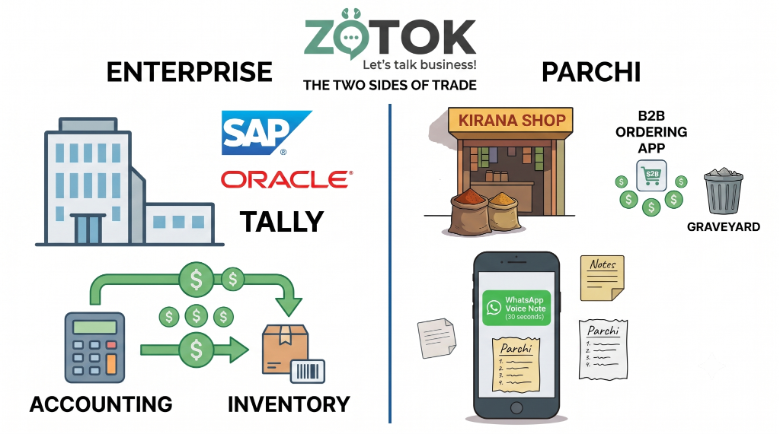
If you walk into any high-volume wholesale hub in India-whether it is the spice markets of Khari Baoli, the textile clusters of Surat, or a bustling regional FMCG mandi-you will notice a striking paradox. The manufacturers and super-stockists at the top of the chain are running multi-million dollar operations backed by heavyweight enterprise software like SAP, Oracle, or customized Tally stacks. They have fully digitized accounting, compliance, and centralized inventory trackers.
But follow that supply chain down one single tier to the ground level, where the brand actually meets the kirana store, the local chemist, or the hardware dealer, and the digital facade vanishes entirely.
The Reality of the Traditional Supply Chain
At the retail and sub-distribution level, the absolute system of record isn't an app, a portal, or a sleek software interface. Instead, the entire ecosystem runs on:
- A torn piece of cardboard or a crumpled ledger sheet.
- A 30-second WhatsApp voice note.
- A blurry, shadow-filled photo of a handwritten list sent at 11:30 PM after the shop’s shutters go down.
This is the 'Parchi' Economy—an informal, incredibly high-velocity conversational marketplace that powers over 80% of India's $1 Trillion retail landscape.
- The Graveyard of B2B Apps: For the past decade, corporate IT departments have tried to "fix" this unstructured chaos. They poured hundreds of crores into feature-rich B2B ordering apps and proprietary Distributor Management Systems (DMS). The market outright rejected them. The failure wasn't a lack of tech literacy; it was a fundamental misunderstanding of traditional retail behavior.
The Ground Reality: Micro-Efficiencies in General Trade
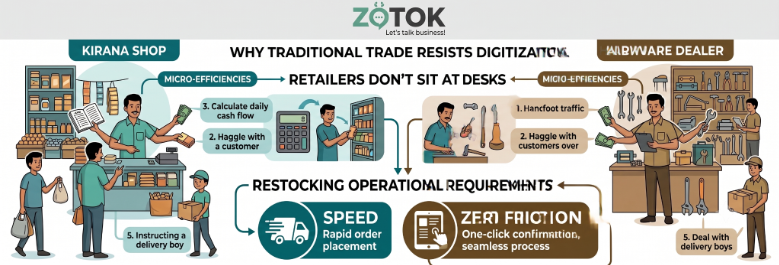
To understand why traditional trade resists conventional digitization, you have to look at how a kirana shop or a hardware dealer operates. An Indian retailer is a master of micro-efficiencies. They do not sit at a desk; they manage foot traffic, haggle with customers, deal with delivery boys, check physical shelves, and calculate daily cash flows all at the same time.
When it comes to restocking, their primary operational requirements are speed and zero friction.
The Shift to WhatsApp
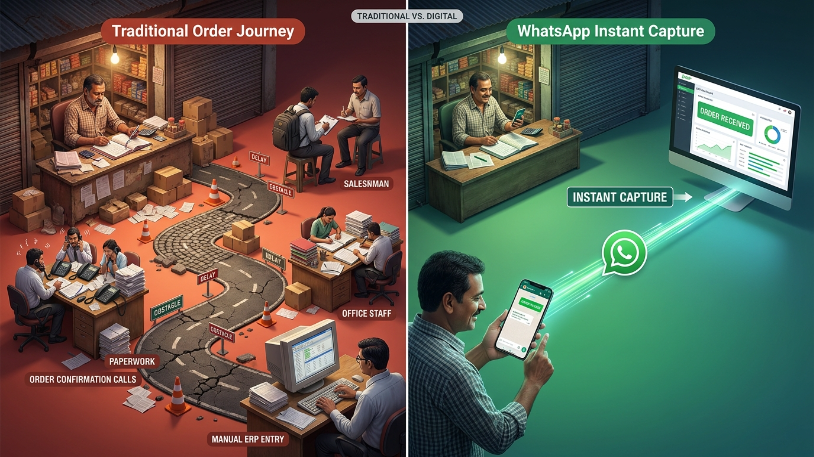
For generations, friction was eliminated by the human relationship between the retailer and the distributor's field sales agent (the DSR). When the pandemic broke that physical bridge, the market migrated organically to WhatsApp.
WhatsApp required zero training, zero storage optimization, and zero onboarding friction. A retailer could simply drop a voice note after closing up shop:
- "Bhaiya, kal subah 20 peti regular waala bhej dena, aur pichle hafte waala extra discount zaroor laga dena." (Brother, send 20 boxes of the regular item tomorrow morning, and make sure to apply last week's extra discount).
While this conversational shift was a massive win for the buyer's convenience, it created a severe operational bottleneck for the manufacturer and distributor back-end. Highly paid sales managers and billing operators were suddenly transformed into data-entry clerks, spending the first four hours of every morning decoding ambiguous text messages, listening to audio notes, and manually punching data into Tally or SAP.
The chaos of physical trade simply transformed into the chaos of digital text
The Tech Mirage: The OCR Adoption Hurdle
Seeing this massive manual transcription bottleneck, technology providers stepped in with what seemed like an elegant fix: Optical Character Recognition (OCR). The promise was simple: snap a picture of the handwritten parchi, and the software will instantly read the handwriting, extract the text, and convert it into a digital format.
However, on the ground in Indian General Trade, basic OCR hits a brutal brick wall for two core reasons:
1. The Nomenclature Gap (Slang vs. Master Data)
Traditional trade doesn't speak in standard SKU names or brand guidelines. A distributor or retailer writing a fast parchi doesn't write "Orient Electric Ultimo 1200mm Ceiling Fan Premium White." They write "Ultimo White 2 pc." An agri-dealer doesn't write out the complex chemical formula of a herbicide; they write a shorthand acronym unique to their district.
Consider a real-world case study from an electrical distribution demo. A dealer wrote down"Tornado Dopes, 5 piece."
- What basic OCR sees: It accurately scans the text and spits out exactly what it reads: "Tornado Dopes."
- What the ERP sees: The system has no idea what a "Tornado Dope" is. To a standard computer, "Tornado" flags a weather event.
- The Context: In the brand's master product catalog, "Tornado" is the colloquial shorthand for a specific line of air coolers, and "Dopes" is a localized spelling slip for "Open" (meaning the open-box variant).
Basic OCR extracts text, but it completely lacks the industry-specific domain intelligence to map that text to an actual billing code.
2. The Ledger and Master Data Mess
Every sub-distributor creates an insulated world inside their local accounting software. When a new product arrives or an item needs to be billed, a local accountant frequently enters it under an arbitrary, highly abbreviated name (e.g., GAH1317-Blue). They do not care about keeping centralized corporate master records clean.
Because traditional OCR only digitizes text literally, it cannot bridge the massive disconnect between a brand's corporate master data, a distributor's erratic Tally ledger naming conventions, and a retailer's localized handwriting..
The Evolution: The Power of Contextual GenAI
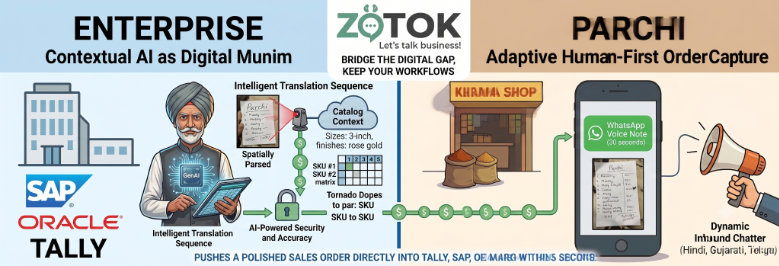
To truly digitize General Trade without triggering an adoption rebellion, the technology must adapt to the human—not the other way around. We do not need to eliminate the parchi or the WhatsApp voice note; we need to make the back-end system smart enough to read them contextually.
This is where Contextual GenAI completely alters the Go-To-Market (GTM) playbook. Unlike literal OCR text-scanners, a contextual AI engine built specifically for enterprise B2B supply chains acts less like a typewriter and more like an experienced, digital Munim (traditional accountant).
| Capability | Basic OCR | Contextual GenAI |
|---|---|---|
| Reading Messy Layouts | Fails if text is non-linear or misaligned. | Spatial Parsing: Identifies layouts non-linearly to isolate item descriptors from quantities. |
| Handling Local Slang | Extracts literal text, causing ERP errors. | Contextual Cross-Referencing: Maps local slang (like "Tornado") to the exact SKU. |
| Resolving Variants | Misses unlisted details or throws exceptions. | Variant Resolution: Matches handwritten sizes or finishes against the live stock matrix. |
The Invisible Background Sync
The true genius of a conversational operating system layer is that it operates as a silent handshake between the buyer's preferred interface (WhatsApp) and the seller's infrastructure (ERP/CRM).
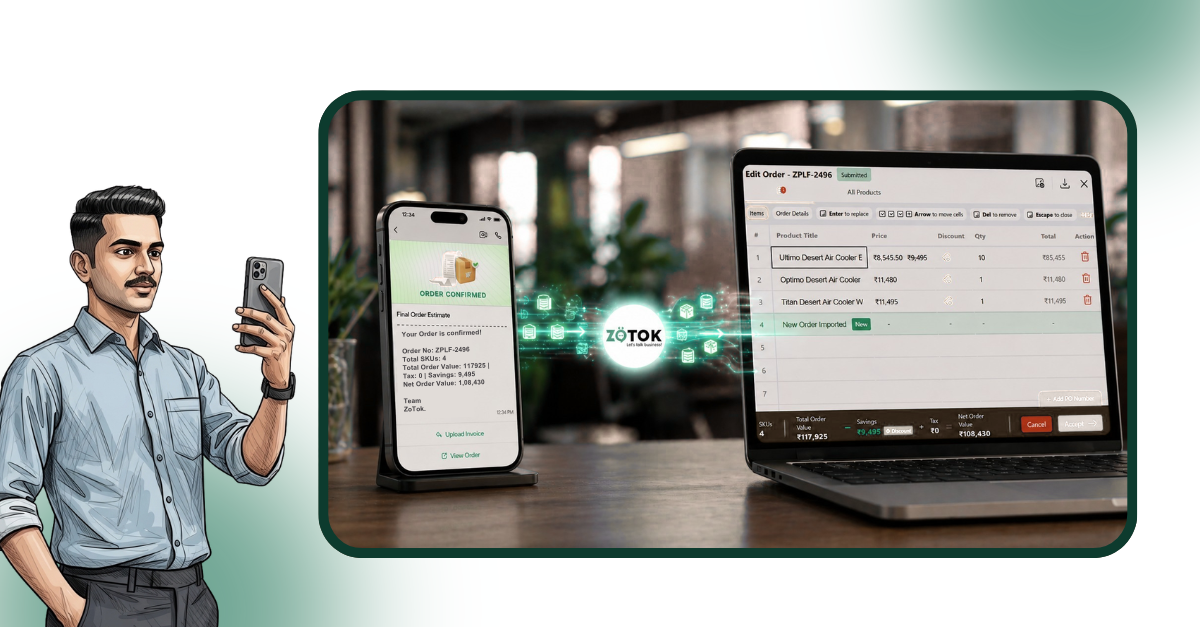
Your back-office billing coordinators change absolutely nothing about their day-to-day workflows. They keep their ERP as the single source of truth. The AI dynamically reads the live catalog data, handles the chaotic, multilingual inbound chatter from the field (whether in Hindi, Gujarati, or Telugu), structures it cleanly, and pushes a polished sales order directly into Tally, SAP, or Marg within five seconds.
Conclusion: Digitize the Conversation, Stop Forcing the App
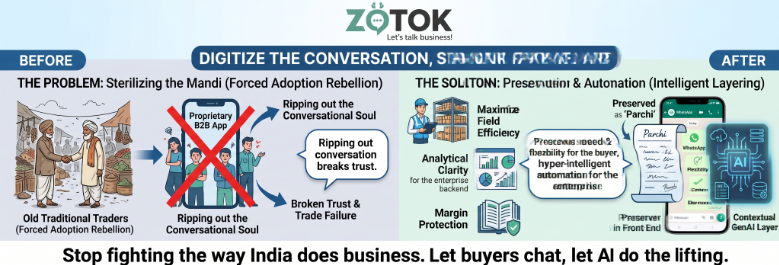
The ultimate lesson of the 'Parchi' Economy is that behavior change in traditional, low-margin B2B ecosystems cannot be engineered by corporate decree. You cannot transform a 50-year-old traditional wholesale market running on relationships into a sterile, app-clicking interface overnight. Ripping out the conversational soul of the mandi breaks the trust that drives the trade.
The future of route-to-market technology doesn't belong to the company that builds the slickest proprietary app. It belongs to the layer that makes the existing, organic conversation hyper-intelligent.
By layering Contextual GenAI over WhatsApp, you preserve the speed, flexibility, and comfort of the traditional paper chit for the buyer on the front end, while delivering the ruthless automation, margin protection, and analytical clarity required by the enterprise backend
Written by -

Blog List
- Decoding the 'Parchi' Economy: Why Basic OCR Fails Indian General Trade
 The 15% Margin Leak — Why Your Credit Cycles Are Stretching (and How to Plug It)
 The B2B App Graveyard: Why Indian General Trade Chose WhatsApp Instead
 The 15% Margin Leak: How Official WhatsApp Groups Are Draining Your Cash Flow
 The Myth of the 9-to-5 Distributor: Bridging the Beat Gap with 24/7 Commerce
 WhatsApp Automation: The Ultimate Guide for Businesses in 2025
 How to Set Up WhatsApp Business for Your Business: The Ultimate Step-by-Step Guide
 Top 10 WhatsApp Marketing Strategies for Indian Businesses: A Comprehensive Guide
 Automating Customer Service on WhatsApp with Zotok.ai's GenAI: The Ultimate Guide for Indian Businesses
 Managing High Volumes of Customer Inquiries on WhatsApp: A Comprehensive Guide for Indian Businesses
 Managing Customer Complaints on WhatsApp Effectively: A Comprehensive Guide for Indian Businesses
 AI Customer Engagement: How Zotok.ai Closes the Sales Loop on WhatsApp
 WhatsApp Marketing
 WhatsApp Order Processing
 Distributor & Reseller Engagement on WhatsApp
 Customer Retention and Support on WhatsApp
 Catalog Sharing on WhatsApp: How ZöTok Solves the Catalogue and Image-Sending Problem for Traders and Business Owners
 Want to Grow Your Business? Use WhatsApp API
 GenAI in General Trade: Transforming India's Distribution Landscape
 Overcoming Distribution Challenges in India with WhatsApp Solutions
 Distributor Management with ZöTok: WhatsApp Commerce and Generative AI Solutions for Smarter Supply Chains
 WhatsApp Business for Brand/Business Owners: Why ZöTok's WABA is the Smarter Choice
 ZöTok: India's First Network CRM Platform Utilizing GenAI on WhatsApp
