


 View Case Studies
 The 15% Margin Leak: How Official WhatsApp Groups Are Draining Your Cash Flow
The 15% Margin Leak: How "Official" WhatsApp Groups Are Draining Your Cash Flow
 Posted by Siddharth Chhallani on April 30, 2026 •6 min read
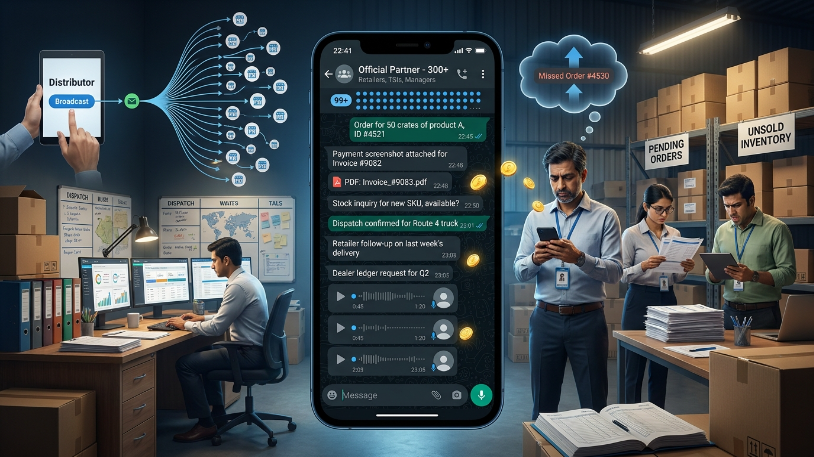
A few years ago, a trend swept through the Indian distribution network. Seeking a quick way to digitize operations, distributors and super-stockists began herding their regional dealers, Territory Sales Incharges (TSIs), and supply chain managers into "Official Partner" WhatsApp groups.
At first, it felt like a masterstroke of efficiency. You could blast an update to 300 retailers at once. You patted yourself on the back for streamlining communication without spending a dime on IT.
In reality, you just created a massive operational blind spot that is quietly locking up your working capital and eroding your razor-thin margins.
The Economics of Indian Distribution
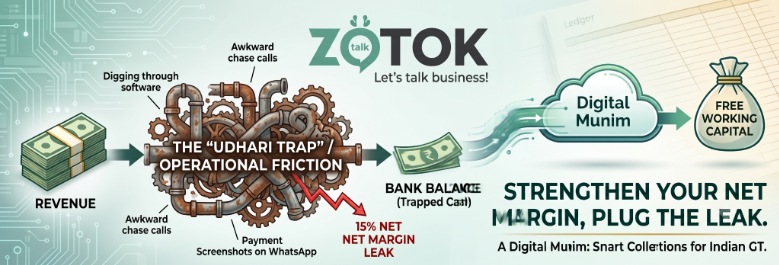
To understand the danger of unstructured WhatsApp groups, you have to understand the brutal economics of General Trade. FMCG and hardware distributors typically operate on net margins of 4% to 6%. Cash flow is oxygen. You act as an informal bank for the supply chain—buying goods from the manufacturer upfront, but extending 15 to 30 days of credit (udhari) to your retailers.
Every day a payment is delayed, and every order that is mispunched, directly attacks your bottom line.
The Noise-to-Signal Nightmare
Let’s look at the daily reality of an MSME WhatsApp group. It is a warzone of unstructured data.
- 09:00 AM: Five different heavily compressed festival greeting images are forwarded into the group.
- 10:15 AM: A dealer asks, "What is my pending ledger balance?"
- 10:45 AM: Another dealer sends a blurry photo of a handwritten order for ₹1.5 Lakhs.
- 11:30 AM: An argument breaks out between a retailer and a logistics guy about a damaged delivery and scheme adjustments.
By the time your sales coordinator sits down to parse this group at 1:00 PM, the massive order is buried under 40 unrelated messages. The dealer who asked for his ledger is frustrated. The entire ecosystem is stalled.
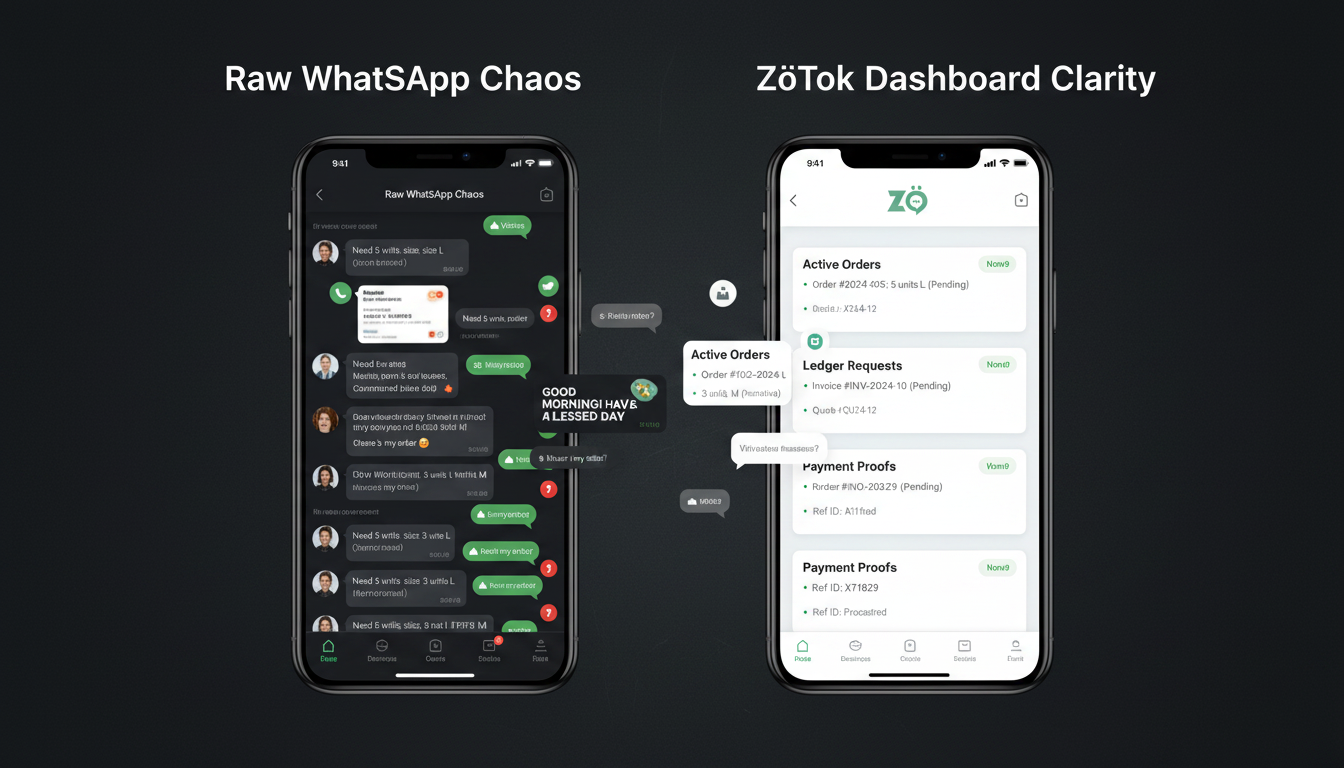
Three Ways WhatsApp Chaos Kills Your Margins
When you rely on humans to decode chaotic WhatsApp groups, you bleed money in three specific ways:
- Stalled Collections (The Udhari Trap): When a dealer asks for an invoice or ledger on WhatsApp, they are implicitly saying, "I am ready to reconcile my books." If your accounts team takes six hours to manually extract the PDF from Tally and send it back, you have just given the retailer a valid excuse to delay payment until the next billing cycle.
- Trade Promotion Leakage: FMCG brands spend up to 15-20% of their gross revenue on trade schemes (e.g., "Buy 10 cartons, get 1 free"). In a chaotic WhatsApp chat, applying the right, currently active scheme to a specific order is a manual nightmare. This leads to rampant over-claiming, misallocations, and margin erosion.
- Wasted Human Capital: Your top sales professionals are not doing what you pay them to do—build relationships, negotiate shelf space, and close deals. Instead, they are squinting at their phone screens, acting as transcribers.
Structuring the Chaos with AI
You cannot ban WhatsApp groups. Your buyers demand direct, immediate access, and if you close the group, your competitor will gladly open one. But you can put a gatekeeper in the middle.
ZöTok’s Agentic AI integrates directly into your business WhatsApp API to act as the ultimate filter. It silently monitors the chaos and extracts only what matters.
- If someone asks for a ledger, the AI instantly fetches the PDF from your ERP and replies in the chat within seconds.
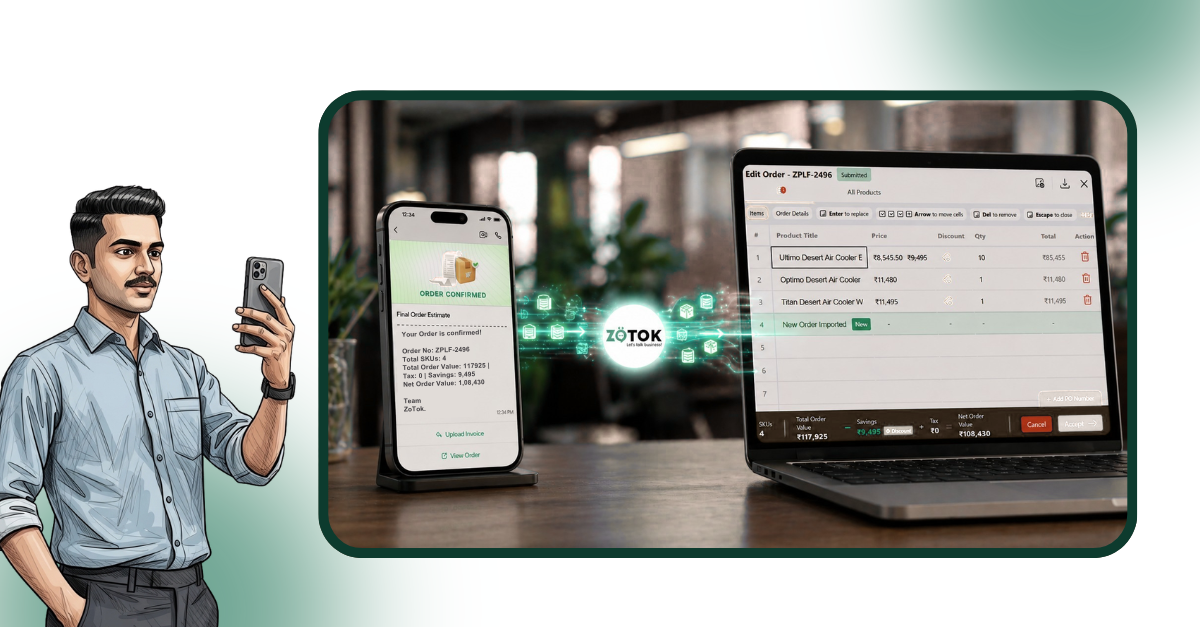
- If someone drops a voice note placing an order, the AI structures the demand, applies the active trade schemes mathematically, asks the buyer to confirm, and logs it straight into your system.
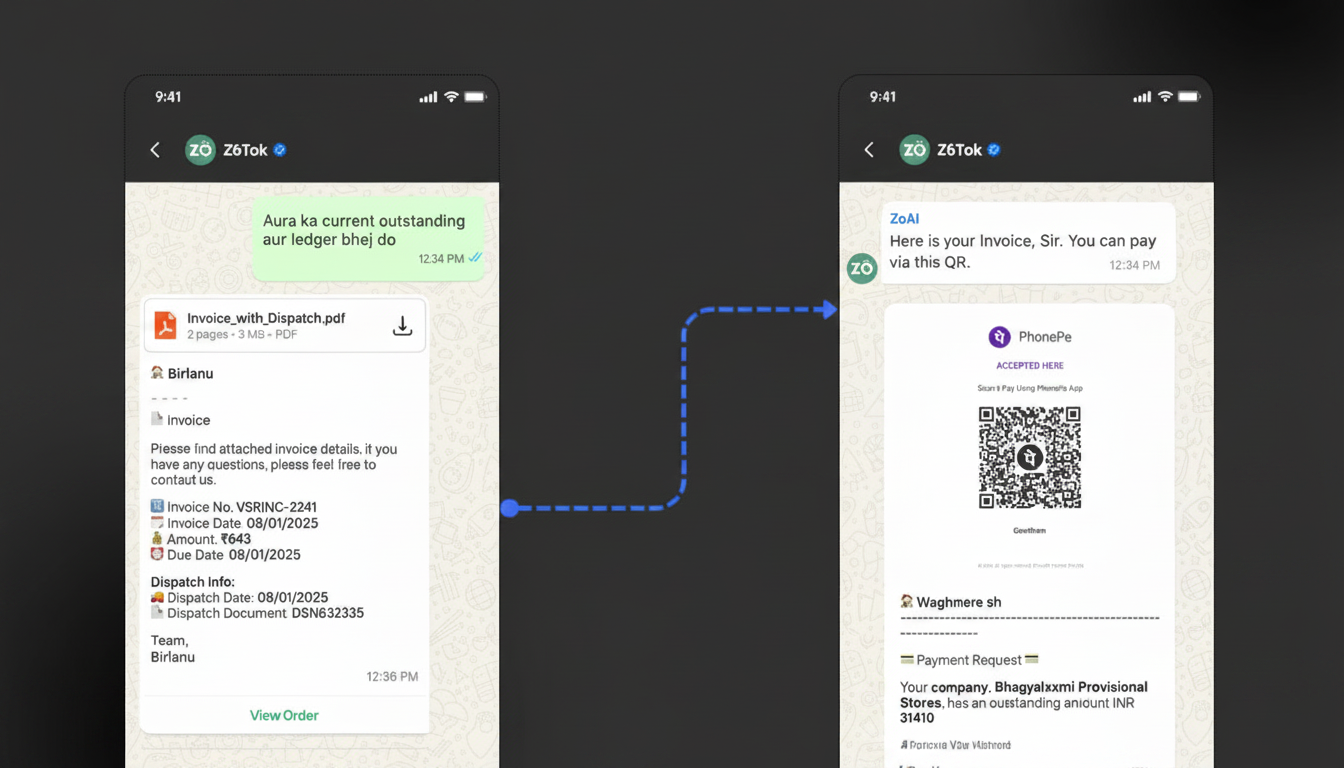
(Note: ZöTok focuses purely on capturing the demand and securing the communication loop. We push the structured data to your ERP, leaving your internal systems to handle the stock-checking and fulfillment mechanics). Stop running a multi-crore distribution network like a neighborhood family group chat. Let the AI handle the data, so your team can handle the business.
Written by -

Blog List
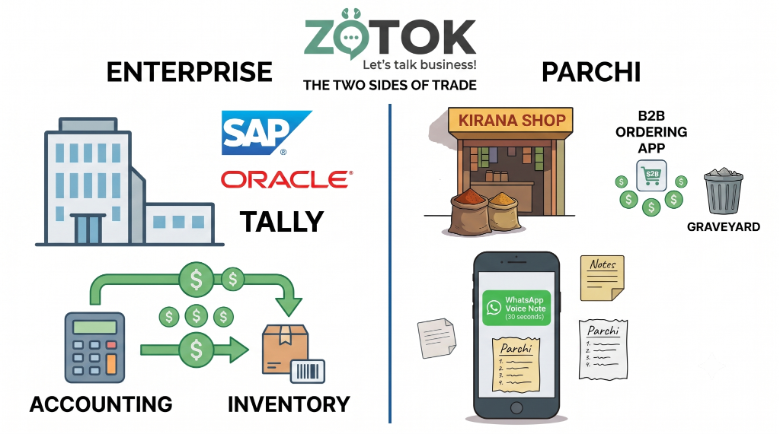 Decoding the 'Parchi' Economy: Why Basic OCR Fails Indian General Trade
 The 15% Margin Leak — Why Your Credit Cycles Are Stretching (and How to Plug It)
 The B2B App Graveyard: Why Indian General Trade Chose WhatsApp Instead
- The 15% Margin Leak: How Official WhatsApp Groups Are Draining Your Cash Flow
 The Myth of the 9-to-5 Distributor: Bridging the Beat Gap with 24/7 Commerce
 WhatsApp Automation: The Ultimate Guide for Businesses in 2025
 How to Set Up WhatsApp Business for Your Business: The Ultimate Step-by-Step Guide
 Top 10 WhatsApp Marketing Strategies for Indian Businesses: A Comprehensive Guide
 Automating Customer Service on WhatsApp with Zotok.ai's GenAI: The Ultimate Guide for Indian Businesses
 Managing High Volumes of Customer Inquiries on WhatsApp: A Comprehensive Guide for Indian Businesses
 Managing Customer Complaints on WhatsApp Effectively: A Comprehensive Guide for Indian Businesses
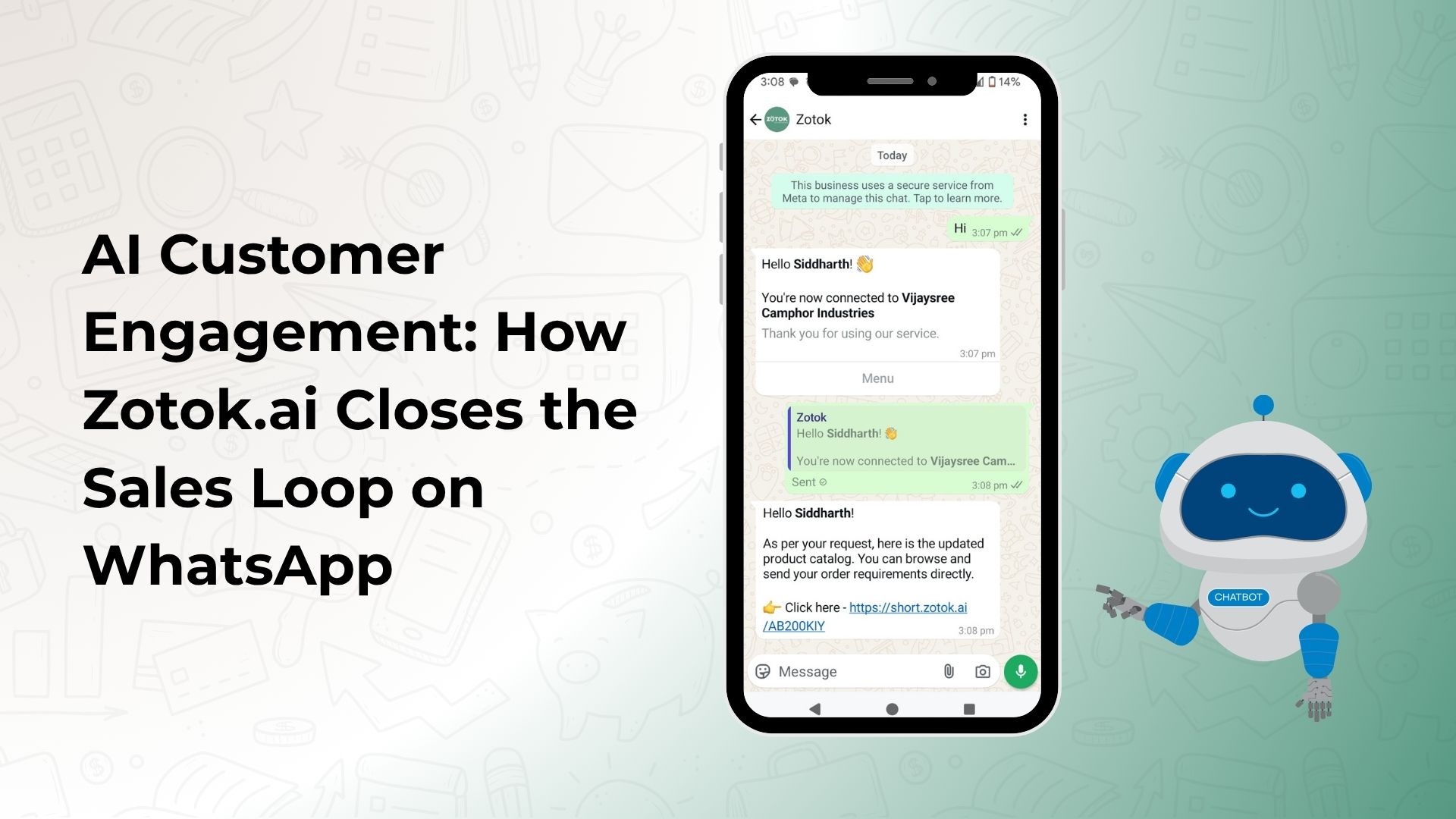 AI Customer Engagement: How Zotok.ai Closes the Sales Loop on WhatsApp
 WhatsApp Marketing
 WhatsApp Order Processing
 Distributor & Reseller Engagement on WhatsApp
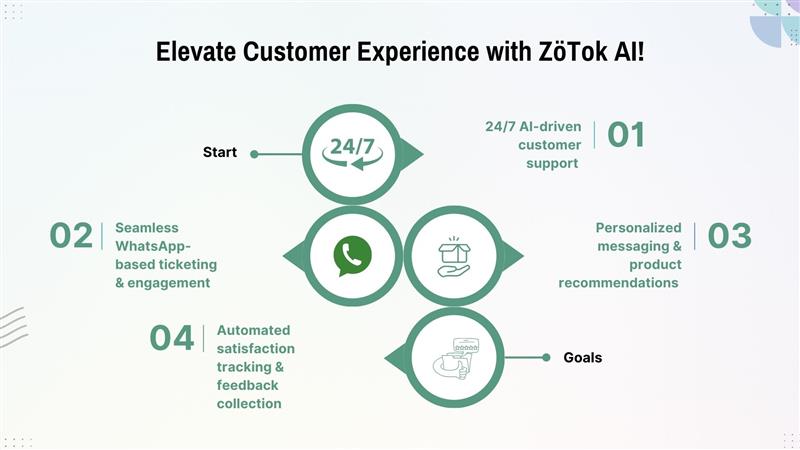 Customer Retention and Support on WhatsApp
 Catalog Sharing on WhatsApp: How ZöTok Solves the Catalogue and Image-Sending Problem for Traders and Business Owners
 Want to Grow Your Business? Use WhatsApp API
 GenAI in General Trade: Transforming India's Distribution Landscape
 Overcoming Distribution Challenges in India with WhatsApp Solutions
 Distributor Management with ZöTok: WhatsApp Commerce and Generative AI Solutions for Smarter Supply Chains
 WhatsApp Business for Brand/Business Owners: Why ZöTok's WABA is the Smarter Choice
 ZöTok: India's First Network CRM Platform Utilizing GenAI on WhatsApp
