


 View Case Studies
 The 15% Margin Leak — Why Your Credit Cycles Are Stretching (and How to Plug It)
The 15% Margin Leak — Why Your Credit Cycles Are Stretching (and How to Plug It)
 Posted by Siddharth Chhallani on July 03, 2026 •6 min read
If you run a manufacturing, super-stockist, or wholesale distribution business in India, your biggest headache isn't top-line growth. Your products are moving, your sales reps are cracking new territories, and your demand graph looks healthy.
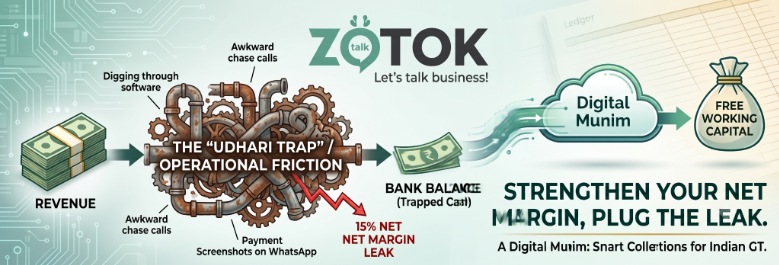
Yet, when you look at your bank account at the end of the month, the cash isn't there. Instead, it is trapped, frozen, and slowly evaporating in a invisible operational bottleneck known across the Indian market as the "Udhari Trap."
In traditional Indian General Trade (GT), distribution businesses lose an estimated 15% of their net margin not to bad debts or poor sales, but to sheer operational friction. It is a silent bleed. It happens in the hours your back-office team spends digging through accounting software, the awkward phone calls your sales reps make to chase down outstanding balances, and the chaotic exchange of payment screenshots on WhatsApp groups.
Every day your average collection cycle stretches from a planned 15-day window into a sloppy 30-day or 45-day reality, your working capital efficiency drops. To keep your supply chain moving, you are forced to look for external financing, absorb cash-flow delays, and watch your hard-earned margins get eaten alive.
Plugging this leak doesn't require a multi-crore, multi-year software overhaul. It requires understanding the exact anatomy of a margin leak and deploying a silent automation layer—aDigital Munim—where your buyers already live.
The Anatomy of a Margin Leak: How 15 Days Becomes 45
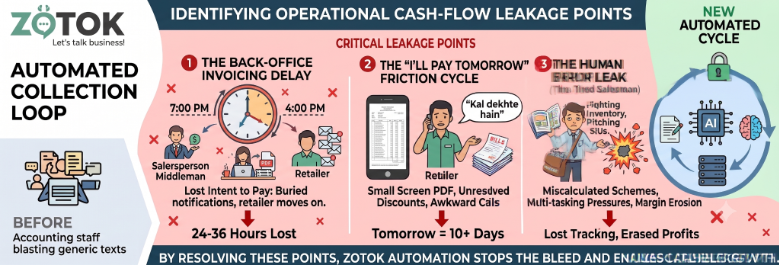
To fix a cash-flow bleed, you have to look closely at the exact sequence of events that stretches a standard credit cycle. The leak occurs across three distinct operational leakage points:
1. The Back-Office Invoicing Delay
A retailer or sub-distributor needs to clear their outstanding balance before they can place their next big order. But first, they need to verify what they owe. They send a casual message to your billing team or field sales rep at 7:00 PM: "Bhaiya, mera live outstanding balance aur pichle do mahine ka ledger copy bhejo." (Brother, send my live outstanding balance and my ledger copy for the last two months).
What happens next?
- Your field sales rep doesn't have live access to Tally or SAP; they have to act as a middleman.
- The request waits until the next morning when the office accountant logs in.
- The accountant searches for the ledger, exports it to an Excel sheet, converts it into a formatted PDF, logs into a desktop computer, and emails or WhatsApps it to the sales rep.
- The sales rep finally forwards it to the retailer late that afternoon.
By the time the retailer receives the document, 24 to 36 hours have been completely lost.The immediate intent to pay has faded. The retailer has moved on to running their daily shop operations, and your ledger is buried under a hundred other unread notifications.
2. The "I'll Pay Tomorrow" Friction Cycle
When the retailer finally gets the ledger, secondary friction kicks in. The PDF text is too small to read easily on a budget smartphone screen. The amount includes an unapplied trade discount or a missing credit note for broken merchandise from three weeks ago.
Because resolving this discrepancy requires another round of back-and-forth phone calls between the retailer, the salesman, and the office accountant, the retailer uses the oldest excuse in Indian trade: "Kal dekhte hain" (We will see tomorrow).
In General Trade, "tomorrow" quickly stretches into 10 days. The retailer keeps your working capital interest-free to fund their own short-term local store expenses, while your business pays the cost of capital delays.
3. The Human Error Leak (The Tired Salesman)
Because chasing payments is an awkward, exhausting process, your field force is constantly under pressure. When a salesman enters a store to collect an outstanding payment, they are balancing multiple tasks: checking inventory, pitching new catalog SKUs, fighting for shelf space, and negotiating collections.
When a trade scheme or dynamic slab-discount is miscalculated or misapplied because a salesman was too tired to cross-reference the fine print of a complex corporate flyer, that error directly erodes your bottom line. You aren't just losing tracking clarity; you are giving away net margin margins on human error.
Plugging the Leak with the "Digital Munim"
Instant Self-Service ledgers
The moment a distributor or retailer messages your official business account asking for a ledger or balance statement, the Zotok AI engine takes over instantly:
- Instant Identification: It instantly identifies the buyer's unique business identity based on their incoming mobile number.
- Real-Time ERP Query: Without human intervention, it securely queries your Tally or SAP database in the background.
- 3-Second Delivery: Within three seconds, it delivers a clean, compressed PDF ledger along with an unambiguous text summary directly into the retailer's WhatsApp chat.
The back-office wait time drops from 24 hours to 3 seconds. The retailer gets their answers instantly, eliminating any room for administrative excuses or collection delays.
Automated Reminders with Dynamic UPI QR Codes
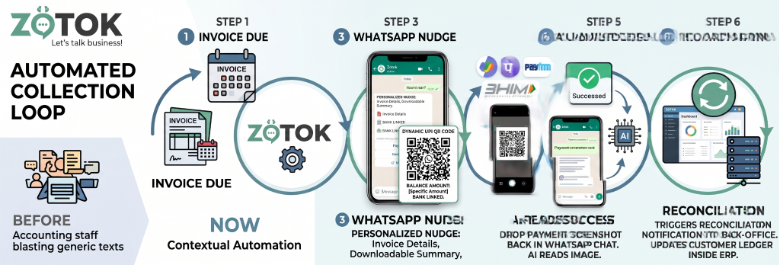
Instead of forcing your accounting staff to manually blast generic broadcast text reminders, the Digital Munim automates your entire collections loop contextually.
When an invoice hits its due date, Zotok generates a highly personalized utility nudge on WhatsApp. It doesn't just say "Your payment is due." It drops the exact invoice details, a downloadable summary, and a dynamically generated UPI QR code containing the precise balance amount tied directly to your corporate bank account.
The retailer doesn't have to manually open a banking app, copy-paste a bank account number, type in an IFSC code, or manually punch in the amount. They simply take a screenshot, open any standard payment app (GPay, PhonePe, Paytm), scan the code, and clear the bill.
Once the transaction is successful, they drop the payment screenshot back into the WhatsApp chat. The AI reads the image, triggers a reconciliation notification to your back-office billing dashboard, and updates the customer's balance ledger inside your ERP.
The Growth ROI: The Power of Shortening Your Collection Cycles
Let's look at the financial math behind shortening your collection loops. If your business does ₹5 Crores in monthly sales distribution volume, and your average collection cycle drops from 32 days down to 24 days by eliminating conversational friction, you instantly unlock 8 days of dead working capital.
That is a direct injection of liquidity back into your production line without taking out secondary bank lines, paying processing interest fees, or adding administrative back-office headcount.
By automating 85% of your standard ledger inquiries, payment updates, and outstanding follow-ups via WhatsApp, you achieve two massive structural milestones:
- Maximize Field Force Efficiency: Your sales representatives stop acting like manual payment-collecting couriers or paper postmen. They focus 100% of their field energy on doing what they are paid to do—driving core distribution growth and launching new SKUs.
- Plug the Margin Leak: You stop losing percentage fractions to capital financing delays, manual entry calculation errors, and misapplied schemes. Your net profit margins stay exactly where they belong—inside your business ledger.
Stop letting your hard-earned revenue bleed out into a manual communication gap. Bring your ERP where your buyers already live, automate the collections loop silently, and let your business scale on auto-pilot.
Written by -

Blog List
 Decoding the 'Parchi' Economy: Why Basic OCR Fails Indian General Trade
- The 15% Margin Leak — Why Your Credit Cycles Are Stretching (and How to Plug It)
 The B2B App Graveyard: Why Indian General Trade Chose WhatsApp Instead
 The 15% Margin Leak: How Official WhatsApp Groups Are Draining Your Cash Flow
 The Myth of the 9-to-5 Distributor: Bridging the Beat Gap with 24/7 Commerce
 WhatsApp Automation: The Ultimate Guide for Businesses in 2025
 How to Set Up WhatsApp Business for Your Business: The Ultimate Step-by-Step Guide
 Top 10 WhatsApp Marketing Strategies for Indian Businesses: A Comprehensive Guide
 Automating Customer Service on WhatsApp with Zotok.ai's GenAI: The Ultimate Guide for Indian Businesses
 Managing High Volumes of Customer Inquiries on WhatsApp: A Comprehensive Guide for Indian Businesses
 Managing Customer Complaints on WhatsApp Effectively: A Comprehensive Guide for Indian Businesses
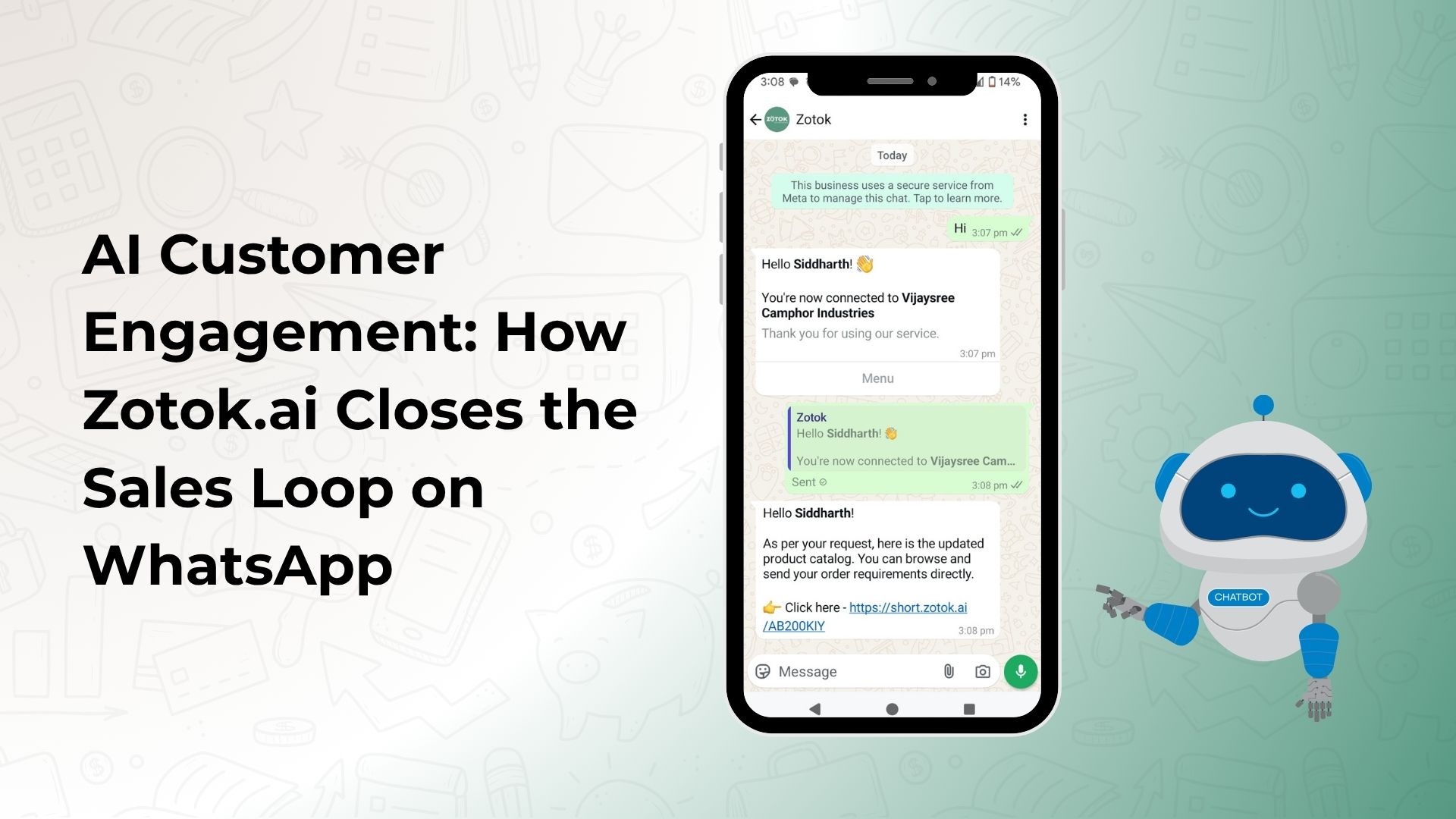 AI Customer Engagement: How Zotok.ai Closes the Sales Loop on WhatsApp
 WhatsApp Marketing
 WhatsApp Order Processing
 Distributor & Reseller Engagement on WhatsApp
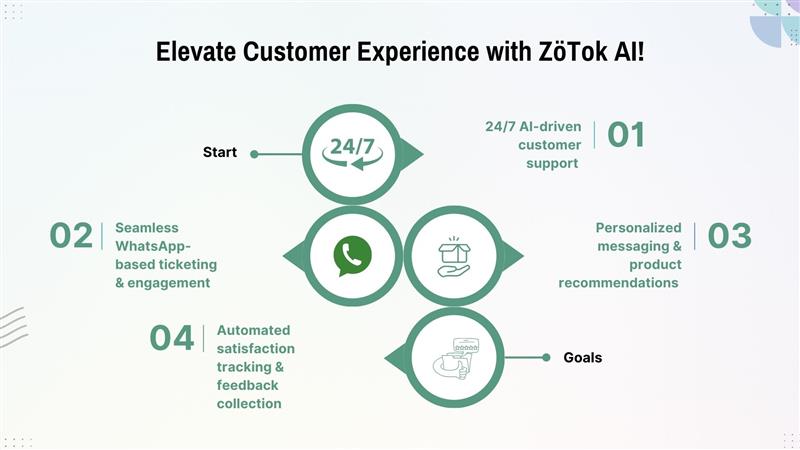 Customer Retention and Support on WhatsApp
 Catalog Sharing on WhatsApp: How ZöTok Solves the Catalogue and Image-Sending Problem for Traders and Business Owners
 Want to Grow Your Business? Use WhatsApp API
 GenAI in General Trade: Transforming India's Distribution Landscape
 Overcoming Distribution Challenges in India with WhatsApp Solutions
 Distributor Management with ZöTok: WhatsApp Commerce and Generative AI Solutions for Smarter Supply Chains
 WhatsApp Business for Brand/Business Owners: Why ZöTok's WABA is the Smarter Choice
 ZöTok: India's First Network CRM Platform Utilizing GenAI on WhatsApp
